In a German war cemetery to the north-east of the Belgian town of Diksmuide is the grave of a young soldier called Peter Kollwitz. He once lay among the 1,500 dead of the Roggevelde cemetery and it was there, in 1932 – the same year that Lutyens’s memorial to the dead of the Somme was dedicated – that his mother, the great German printmaker and sculptor Käthe Kollwitz, placed at his graveside the two granite figures known as the ‘Grieving Parents’.
There is, as the historian Jay Winter wrote, ‘no monument to the grief of those parents who lost their sons in the war more moving than this simple stone sculpture’ that had been 18 sorrowing years in the making. The father kneels bolt upright in a state of frozen misery, while the mother, her head bowed in grief and guilt, prays for her son’s forgiveness for her own and her generation’s complicity in the horrors of the Great War.
Even after a century – or perhaps especially after a century shaped by the catastrophic fall-out of that war – there is little temptation to forgive the generation that sent Peter Kollwitz to the slaughter. By the end of the first August, up to 100,000 lay dead on the Western Front, a figure which would double within a fortnight and more than double again by the end of a year that claimed an obscene half a million French, German, Belgian and British lives.
Robert Cowley’s book begins with Germany’s brutal invasion of Belgium and culminates in the long and bloody struggle for Ypres and stalemate on the Western Front. ‘Why was the killing of these early months so inordinately high?’ he asks, and provides his own ‘simple’ answer:
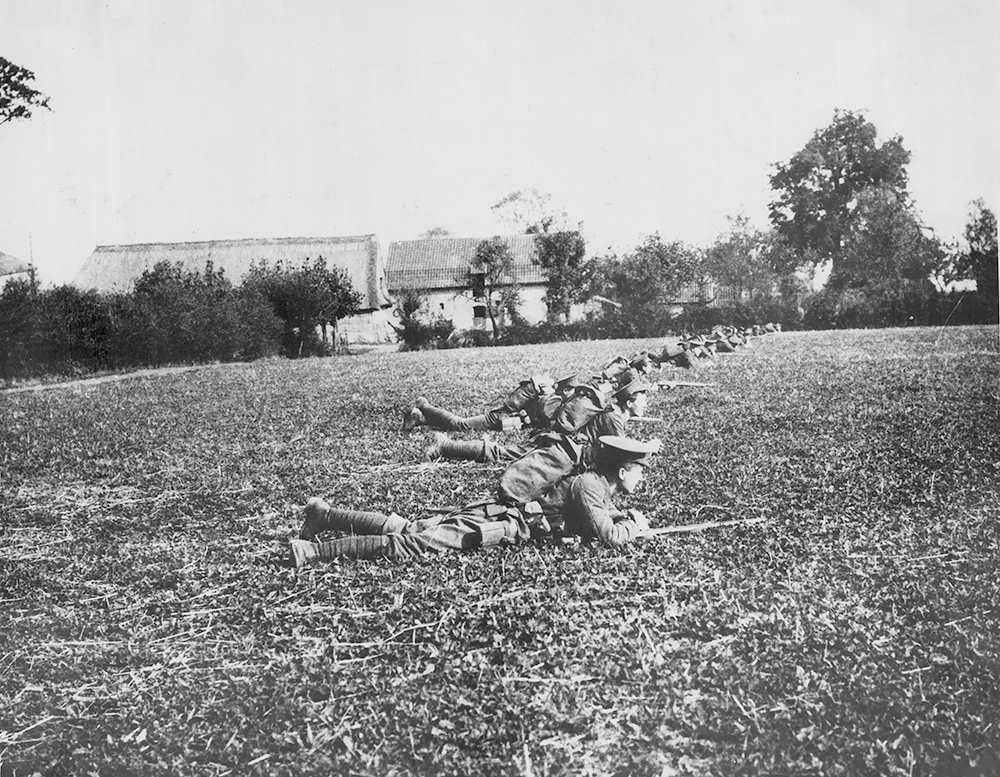
Open warfare is far more murderous than fighting from prepared defensive positions. During much of that summer and autumn, the opponents clashed above ground in exposed and unprotected country, in one of the most domesticated, but for soldiers dangerously open, landscapes on Earth, amply patterned with fields and well-regulated woodlands, like lethal parks that too often offered unobstructed avenues of fire.
This, then, is the setting for The Killing Season, and for what, curiously, seems to Cowley a crucial and unjustly neglected phase of the war. He is right, of course, that it is the trenches that dominate the popular imagination, but these months are hardly forgotten either in France or in Britain – where the death of her old professional army and the names of Mons and Ypres are as firmly enshrined in national mythology as Waterloo, Balaclava or the field of Agincourt.
It is hard to know what to say about a book that is compelling and frustrating in about equal measure. It was clearly an editorial nightmare in its first ‘elephantine’ form; and even after a major rewrite it still feels one last editorial cull away from being the disciplined, coherent narrative that such a confused and confusing phase of the war requires.
While it might not much matter that there is no bibliography, what does matter is that, with the exception of one crowded diagram of the Ypres Salient at the front, there are no maps to help the reader out. If Cowley was writing about the trenches, this wouldn’t be such a serious omission; but his ‘killing season’ was a war of movement, of offensive and counter-offensive, spread across hundreds of miles. How anyone is expected to navigate unaided the vast and sprawling battles of the Marne or the Frontiers (Max Hastings’s Catastrophe comes in handy here) is a mystery.
The quid pro quo for all this – the digressions, the repetitions, the academic sparring – is an energy and passion that never flags. Cowley’s father served in France with the Americans in the first world war, and the son has lived with it his whole long life, immersing himself in its characters, blunders and lost opportunities, as if the war were not history but current and urgent – the fate of a single battle, of the conflict as a whole, of 20th-century Europe all still hanging perilously in the balance.
It is this, along with a mastery of sources, German as well as French and British, that give a familiar narrative and cast list a remarkable immediacy. There is no Olympian detachment here, no authorial distance. Cowley is, it feels, as much a participant as a historian. He is present on every page, questioning, speculating. He is in the room with the wavering Sir John French; there with Charles FitzClarence on the last desperate day of October at Gheluvelt; there with British soldiers scratching out their shallow trenches in the Salient – and there, like it or not, are you, too.
You might not know exactly where ‘there’ is. You might not know where in the Ardennes you are supposed to be; where the sluice gates are that will save the last patch of unoccupied Belgium. You might have lost track of which bank of the Yser or side of the Menin Road you are on. But you will feel, as far as that is ever possible, what life and death were like among the horrors; how it felt to sit under a bombardment; to break under pressure; to loose off round after round into a crowded, grey mass of German volunteers emerging out of the mist of an October morning; to stand at the grave of the 18-year-old Peter Kollwitz, who had been buried at night in the sodden Belgian earth, his fighting war – begun in a blaze of patriotic fervour – no more than hours, maybe only minutes, long.
This is visceral, combative, sometimes hyperbolic, collar-grabbing stuff. No one reading The Killing Season will ever need to read another book on the First Ypres – nor, quite possibly, will they want to.


Comments