
‘Places in Cookham seem to me possessed by a sacred presence of which the inhabitants are unaware,’ wrote Stanley Spencer. Mystically devoted to the Berkshire village near the Thames where he grew up, Spencer was synonymous with Cookham as early as 1912, when he was at the Slade; ‘Cookham’ was his nickname. His greatest work is probably ‘The Resurrection, Cookham’ (1924-7), and he lived out his life there. He became known for pushing an old pram full of paints around town. The former Wesleyan Chapel, where he worshipped as a boy, is now the Stanley Spencer Gallery.
So it was intriguing to come across this new show connecting him with Suffolk. Hosted by Gainsborough’s House in Sudbury, the exhibition promises to reveal how Suffolk played ‘a crucial role in his complex personal history’. Stepping into the gallery space adjacent to the historic House, you feel the thrill of entering Spencer’s disconcerting world. All his work carries a special charge, pure and impure, in love with all creation, original, odd. It makes total sense that he adored John Donne.

The Suffolk work is, in truth, on the more safe side of his oeuvre, and there isn’t that much of it, so the show is enjoyably fleshed out with other pieces that help tell the story. In 1919 Spencer fell in love not just with Hilda Carline but her whole milieu: the ‘cercle pan-artistique’ of working artists living on Downshire Hill, Hampstead (those were the days). There is an intense self-portrait here by Carline, and another by her brother the artist Richard, also rather dour, but helpful so you can spot him coming out of his grave when next looking at ‘The Resurrection, Cookham’ in Tate Britain.
In 1925, they married in Suffolk in the village of Wangford, not far from the coast. Spencer accidentally saw Hilda at a fitting for her wedding dress, taking such fright he tried to break the whole thing off. At his request the bride wore ‘ordinary clothes’: a black-and-olive striped number, on display here, which she paired with a black tricorn hat (missing in action).
The priapic-sounding Wangford, where they honeymooned, would ever be part of his erotic imagination. They chose Wangford because it was where Hilda had worked as a land girl in the first world war, tilling, hoeing and living in a Romany caravan.
Spencer’s landscapes from this period included portentous images of captivity (natural, perhaps, for a newlywed), such as ‘Tree and Chicken Coops’ (1925), and the mysterious ‘Turkeys’ (1925), which shows the birds behind a wooden star-shaped structure, green with mould, fences upon bars upon fences. Hilda’s panorama ‘Smoke From the Southwold Train’ isn’t here, but there is her earlier, atmospheric ‘Melancholy in a Country Garden’ (1921) suffused with the loss of her father. ‘You know I love your work, it is one of the few things I can say honestly about you,’ wrote Spencer.
Hilda and Stanley had two daughters, Shirin and Unity, and with his career flourishing, the family was just settling into a home in Cookham – when he met his femme fatale Patricia Preece. His 1935 nude of Preece is still outrageous. Her breasts dominate, monumental and overwhelming, while her eyes, relegated to the perimeter of the painting, flash with challenge. It’s obsessional, proto-Freudian (Lucian), appalling and real. Spencer is painting on a whole new level. He likened his painstaking process to that of an ant exploring the contours of the human body.
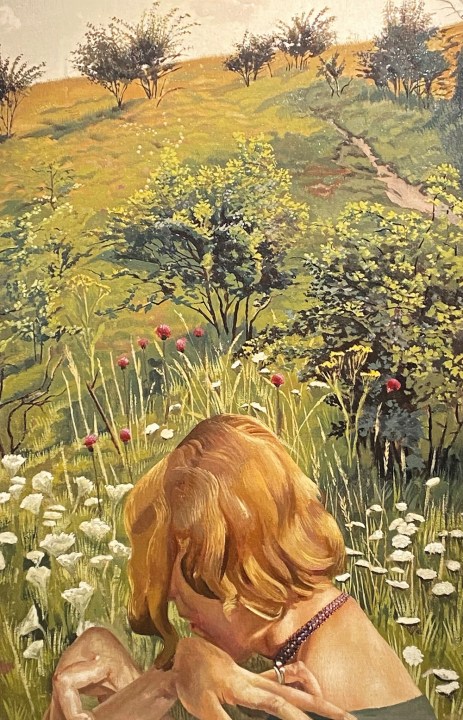
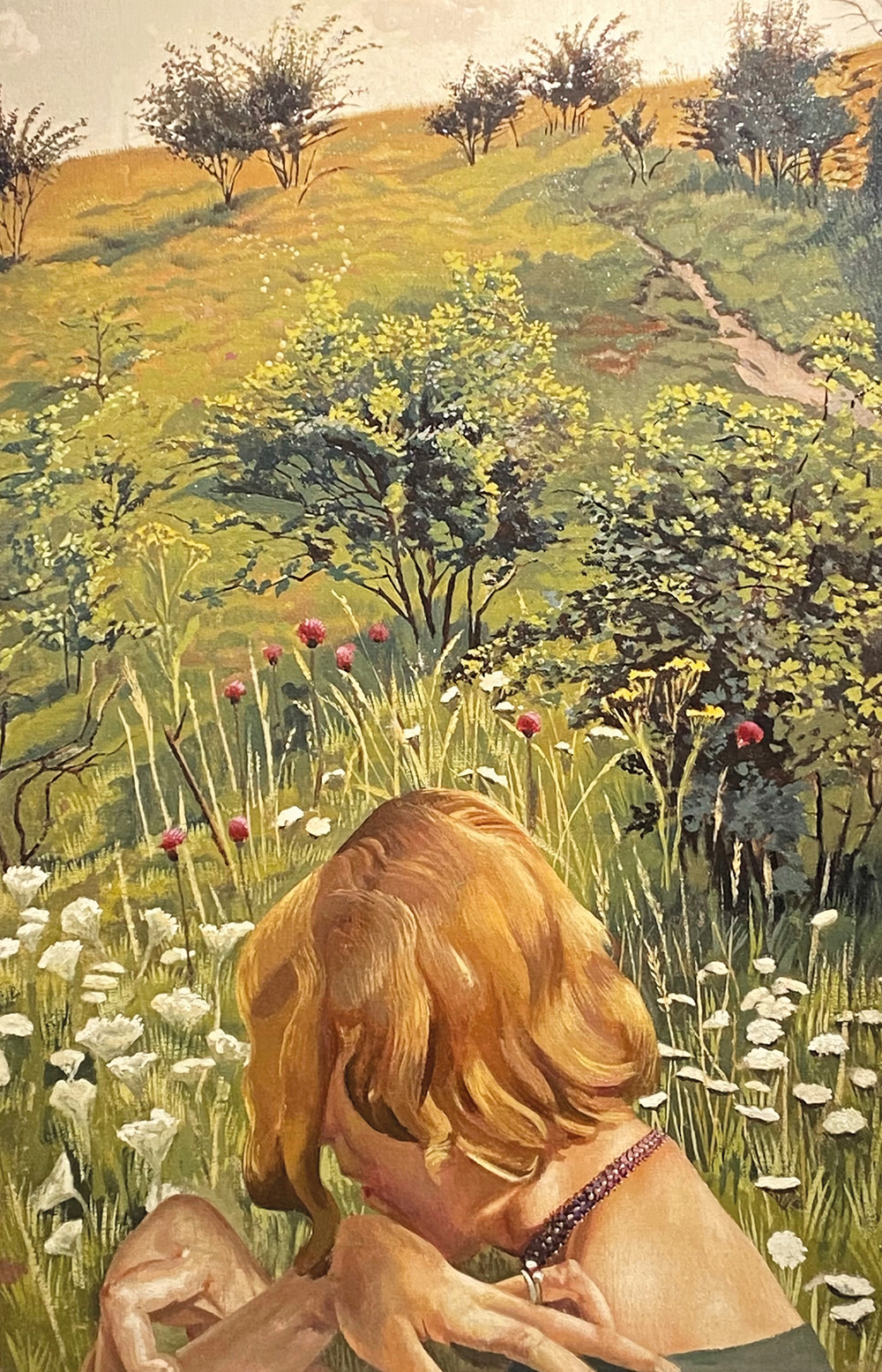
Preece he found intensely glamorous and worldly, and lavished gifts on her, such as the ring we see here glittering on her finger in ‘Patricia at Cockmarsh Hill’ (1935), as well as the deeds to the Cookham home – leaving Hilda and the girls hard up and displaced. It’s a shocking story.
The 1937 Spencer-Preece wedding photo is reproduced in the catalogue. Spencer, 5ft 2in, is wearing bottle glasses, floppy hat and a braced, happy-go-lucky expression, like Charlie Chaplin about to get shot out of a canon. Preece presents an elegant front, beside her lesbian lover, Dorothy Hepworth, who is in tweed and a tie; while Spencer’s best man Jas Wood tries to smile. The couple separated almost immediately. The planned honeymoon trip to St Ives was taken by Preece and Hepworth, while Hilda briefly got back together with Spencer. He began to think what he really wanted was a menage à trois.
By this point neither Patricia nor Hilda would go with him to Wangford. So he went alone. ‘I’ve got two wives, one divorced and one not, and feel equally married to both,’ he announced. This ‘complex’ situation (i.e., a total nightmare) has been much interpreted and even dramatised, including by Pam Gems in her highly regarded 1996 play Stanley.
It all makes slightly more sense, I think, if one agrees with his 1962 biographer Maurice Collis that Spencer had a masochistic streak, and liked how mean Preece was to him, even sought it out. There’s a kinky 1943 sketch of himself as Patricia’s dog, leashed by his tie, but that’s in the Collis biography. This exhibition, curated by the trustees of the Spencer Gallery, simply expresses a diplomatic sense of regret for the mess.
While staying alone in Wangford in 1937, he painted the beachscape ‘Southwold’, the apogee of his Suffolk work. One can feel his declared sense of alienation from the couples sunbathing – everything, except for him, is in a pair, even the groines going down to the sea. Spencer was a committed optimist, however. Southwold’s shore had been fortified in the first world war, and there are echoes of that here, only the barbed wire has become a clothesline strung with bathing suits, and the landmines are deckchairs.
His longed-for reconciliation with Hilda never happened; she died of cancer in 1950. Still he continued to write to her. ‘Come ducky and tread on the moor with me…’ He even wrote to her to let her know that he was home safe from a trip to China in 1954, as part of an official delegation including A.J. Ayer and Sir Hugh Casson. Apparently, the great plain by the Ming tombs of Peking reminded him of nowhere so much as Wangford. The similarity was based on the numinous sense of future possibility that he felt there.
He wanted to divorce Preece but she disallowed it and claimed herself Lady Spencer after he was knighted in 1959. But a better way to remember him is by his wonderful late self-description: ‘All my life has been like watching fish in the clear water below Cookham bridge. If I am lazy, I am a lazy angel in heaven.’


Comments