Papal conclave

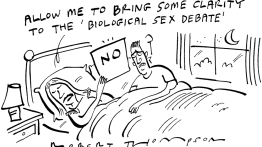
‘Great news! I’ve found out what a woman is.’

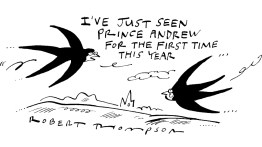
‘We’re choosing a new leader.’
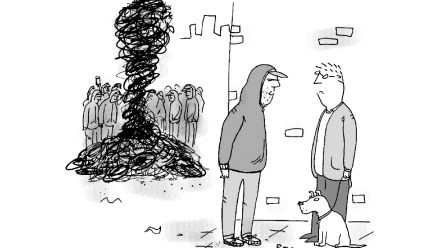

‘It’s nice to see blue rinse is popular again.’
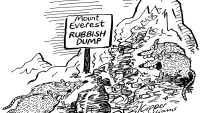
‘It’s that lovely couple we met in Birmingham.’
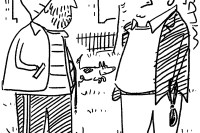
‘Gail and I are staying together for the sake of the pets.’
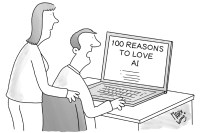
‘I think it’s another article written by AI.’


Any sane proponent of Britain’s liberal democratic values should be angry. We are facing an apparent crackdown on our once-robust freedoms in the form of a ban on banter. A tweaked clause in Angela Rayner’s Employment Rights Bill, currently making its way through parliament, says that employers must take ‘all reasonable steps’ to prevent harassment of their staff by third parties. It is intended to relieve ‘anxious’ staff of the fear of going to work and being upset by colleagues or punters, and has caused a total meltdown on the free speech right. Rightly so. The bill could indeed equate to a clampdown on normal back-and-forth between human beings. There

Apparently, it was Lytton Strachey who coined the term ‘filth packets’ when he was describing Virginia Woolf’s room of her own; for Virginia this meant envelopes containing bits of this and that – old nibs, bits of string, used matches, rusty paper clips, all the stuff that gathers on the desk of a writer, or did in the 1920s. According to Lytton, Virginia sat in the kind of armchair very familiar to me to write, which appeared to be suffering from ‘prolapsis uteri’. Nevertheless, in spite of her filth packets, Virginia had staff – albeit not as many as there were in the house where she grew up in Kensington
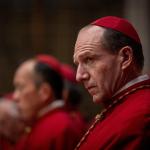
Next week, after Francis’s funeral, the College of Cardinals will assemble in Rome to choose the man who will lead their Church through these increasingly troubled times. That gathering has become more familiar to a wider, non-Catholic public thanks to the recent films Conclave and The Two Popes – though these are far from the first time that novels and the silver screen have made a drama out of a conclave. This assembly is unlikely to echo the fiction of Robert Harris’s thriller and its screen version starring Ralph Fiennes. The next pope is almost certain to be a liberal in the mould of Francis himself, whereas in Conclave (spoiler

In 1906, Sir Francis Galton observed a crowd at a country fair in Plymouth attempting to guess the weight of an ox. Nearly 800 people participated – from butchers and farmers to busy fishwives. Galton, ever the measurer of men and beasts, gathered the guesses and calculated their average. The result was startling: the crowd’s collective estimate came within one pound of the actual weight. This elegantly simple experiment is the founding parable of what we term the ‘wisdom of crowds’ – the idea that while individuals may be flawed, the collective judgment of a sufficiently diverse group is compellingly accurate. Galton’s experiment also became one of the great justifications

Next month marks the 23rd anniversary of the launch of LinkedIn, the most awful of all the social media networks. It used to be about business. These days it’s a parallel universe where the sort of nonsense you once shared with your family and close friends on Facebook – births, deaths, marriages, attention-seeking ‘U OK HUN?’ sad selfies, angry rants, happy birthday messages, saccharine memes and cryptic quotes are chewed up and regurgitated into smug self-promoting drivel or, worse still, marketing blurb. I was made redundant in November and the worst thing about the past five months has been having to go on LinkedIn. Naively, I believed I could upload

A recent study by the Centre for London thinktank claims that the city’s black cabs could disappear forever, unless something is done to reverse the decline. Thanks to Uber, the ubiquitous satnav which devalues the cabbies’ hard-earned Knowledge of London’s streets, and the Mayor’s anti-motorist measures, there are ever fewer black cabs rumbling around the capital. The number dropped from more than 23,000 in 2014 to just under 14,500 last year – down by a third. Only a hundred licences were handed out last year. At this rate, we are told, they will vanish altogether by 2045. Well, tough. I’ve been a Londoner for half a century and have had

Seeing that photograph of J.K. Rowling, I reflected gleefully that her journey from mousey, play-nice moderate to unapologetically glam and flamboyantly defiant fox is complete. It’s not often that glamour and righteousness come along in one person – but when it occasionally happens, as her caption said, ‘I love it when a plan comes together.’ Many brave people – mostly women, but joined by a few exceptional men – have sacrificed much for the victory we finally took receipt of in the Supreme Court last week. They have been robbed of reputations, careers, relationships and – almost – sanity, as much of the world’s establishment and institutions went gender-woo gaga

The last time I saw Graydon Carter, editor of Vanity Fair for 25 years, he was strolling along Jermyn Street in London. Graydon was a media-land acquaintance from LA and New York where I worked as a journalist in the 1990s. We gossiped affably for a few minutes about mutual British friends before heading back to our different lives (him to a suite at the Connaught, me to a rented flat in Pimlico). It wasn’t until I read his entertaining new memoirs, When the Going Was Good, that I realised quite how very different our lives had become ever since I met him at Vanity Fair’s first Oscar party in
I blame The Spectator. The chain of events that has led me to be christened and confirmed in the Anglican Church began with an article I wrote for Spectator Life in January. I had spent New Year’s Eve with a friend, a former vicar, who had lost his faith and honourably resigned his living as a result. He claimed that most contemporary clergy no longer believe in the basic tenets of Christian doctrine: the divinity and miracles of Christ; the Virgin birth; the resurrection; life after death; even the very existence of God. I wrote an article bemoaning this, and mourning the decline of the Church as an essential element

Lindt has opened a ‘first of its kind’ flagship store at Piccadilly Circus. Roger Federer was wheeled out to cut the ribbon. It features the UK’s largest Lindt truffle pick ’n’ mix counter (a snip at £6.50/100g), a ‘barista-style’ hot chocolate bar and an ice cream station. There’s even jars of chocolate spread for those who consider Nutella lowbrow. Lindt’s CEO for UK and Ireland, in that PR corporatese that sounds like guff to everyone except his marketing department, said: ‘With 2025 marking Lindt & Sprungli’s 180th anniversary, what better way to celebrate this journey and enduring passion for captivating chocolate lovers worldwide.’ It’s enough to make me crave Quality


The weather is going to have a big bearing on the result of the BoyleSports Irish Grand National on Easter Monday. There is plenty of rain forecast between now and the off, and if that prediction is correct, the ground is going to be “soft”, or even “heavy”, by the off. I am loathe to desert Haiti Couleurs after he did this column a favour winning at the Cheltenham Festival: put up at 8-1, Rebecca Curtis’s game gelding won the Princess Royal National Hunt Challenge Cup Novices’ Handicap Chase at 7-2 by a comfortable four and a half lengths. Haiti Couleurs is a magnificent, precise jumper and seems to go
